When sourcing polyester fiber acoustic panels, buyers often receive test reports from manufacturers. These documents provide important information about sound absorption, fire performance, and product specifications.
However, technical terms such as NRC, ASTM C423, and EN 13501-1 can be confusing if you are not familiar with acoustic testing.
Understanding these reports helps you compare suppliers, evaluate product performance, and confirm whether the panels meet your project requirements.
Here are six important things to check when reading a polyester fiber acoustic panel test report.
1. Check the Product Specifications
Before reviewing the test results, make sure the report describes the product you intend to purchase.
Pay attention to:
- Product name and material composition
- Panel thickness and density
- Sample dimensions
- Product structure and surface treatment
- Manufacturer information
For example, a report for a 12 mm PET acoustic panel should not automatically be treated as proof of performance for a 24 mm or 30 mm panel.
Different thicknesses, densities, and structures may produce different test results.
Tip: Ask the manufacturer to confirm that the tested sample matches your actual product specifications.
2. Understand NRC – Noise Reduction Coefficient
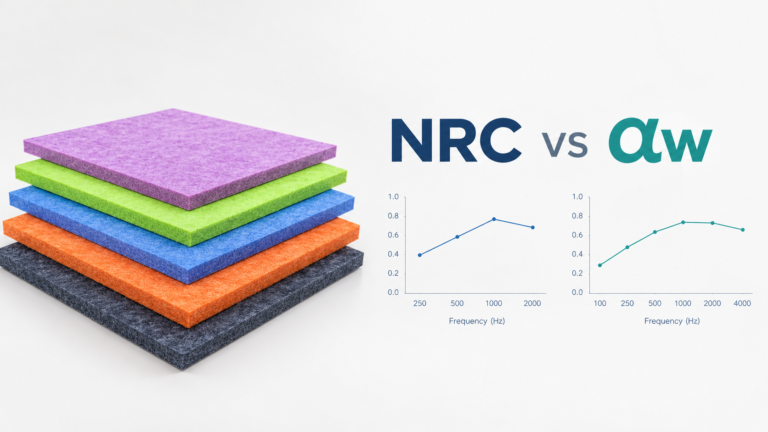
NRC stands for Noise Reduction Coefficient. It is a single-number rating commonly used to describe the sound absorption performance of acoustic materials.
The rating is generally reported on a scale from 0 to 1, with higher values indicating greater sound absorption.
For example, an NRC of 0.80 indicates relatively high sound absorption under the relevant test conditions.
However, NRC does not mean that a panel blocks 80% of outside noise. It measures sound absorption, not sound insulation.
When checking NRC results, pay attention to the test standard, panel thickness, mounting method, and test conditions.
For a more complete evaluation, it is also useful to review sound absorption coefficients at different frequencies.
3. Check the Sound Absorption Test Standard
The test standard tells you how the acoustic performance was measured.
Two commonly referenced standards are:
ASTM C423
This standard measures sound absorption in a reverberation room. The results can include sound absorption coefficients at different frequencies and an NRC rating.
ISO 354
This standard also measures sound absorption in a reverberation room. Results are generally presented as sound absorption coefficients across different frequencies.
When comparing reports from different manufacturers, check whether the same testing standards and comparable conditions were used.
Do not rely on a single NRC value alone. Frequency-based results provide more information about how a panel performs across different sound ranges.
4. Understand the Fire Performance Classification
Fire performance is particularly important for commercial buildings, offices, schools, hotels, and public spaces.
Depending on your project and target market, you may encounter these standards:
ASTM E84
This test evaluates the surface burning characteristics of building materials. The report commonly includes:
- Flame Spread Index (FSI)
- Smoke Developed Index (SDI)
Class A under ASTM E84 is commonly associated with an FSI of 0–25 and an SDI of 0–450.
EN 13501-1
This European standard classifies the reaction to fire of construction products.
You may see classifications such as A1, A2, B, C, D, E, and F, together with additional smoke (s1–s3) and flaming droplets (d0–d2) classifications where applicable.
Remember that ASTM E84 and EN 13501-1 use different testing and classification systems. Their results should not be directly converted or treated as equivalent.
Always confirm which fire performance requirements apply to your project.
5. Verify the Testing Laboratory and Report Details
A reliable test report should contain enough information to verify its source and testing details.
Check the following:
- Testing laboratory name
- Report number and test date
- Sample description
- Testing standard
- Test results
- Laboratory accreditation, where applicable
If the report comes from an accredited laboratory, check whether its accreditation covers the relevant testing method.
It is also advisable to request the complete report rather than relying only on a certificate image or a supplier’s summary.
6. Confirm That the Report Matches Your Order
This is one of the most important steps before placing a bulk order.
Check whether the tested product has the same:
- Material composition
- Thickness and density
- Product structure
- Surface treatment or facing material
For example, a test report for a plain PET acoustic panel may not automatically apply to a PVC-faced, laminated, or composite panel.
If you are ordering customized products, ask the manufacturer whether the existing report covers your specific design or whether additional testing is required.
Final Thoughts
A polyester fiber acoustic panel test report provides valuable information about sound absorption, fire performance, and product specifications.
When reviewing a report, do not focus only on one number or classification. Check the product details, testing standards, laboratory information, and whether the tested sample matches the product you plan to purchase.
At Wayson, we manufacture polyester fiber acoustic panels in different thicknesses, colors, and customized designs. We can provide available product documentation and ASTM fire test reports for customer reference, depending on the product and project requirements.
Looking for PET acoustic panels for your project? Contact Wayson to discuss your product specifications and available test documentation.