Polyester acoustic panels may look simple, but producing a stable and consistent panel involves several important processes. From polyester fiber preparation to final packaging, each step helps determine the panel’s thickness, density, appearance, and acoustic performance.
Here is a simple look at the production process of polyester acoustic panels in our factory.
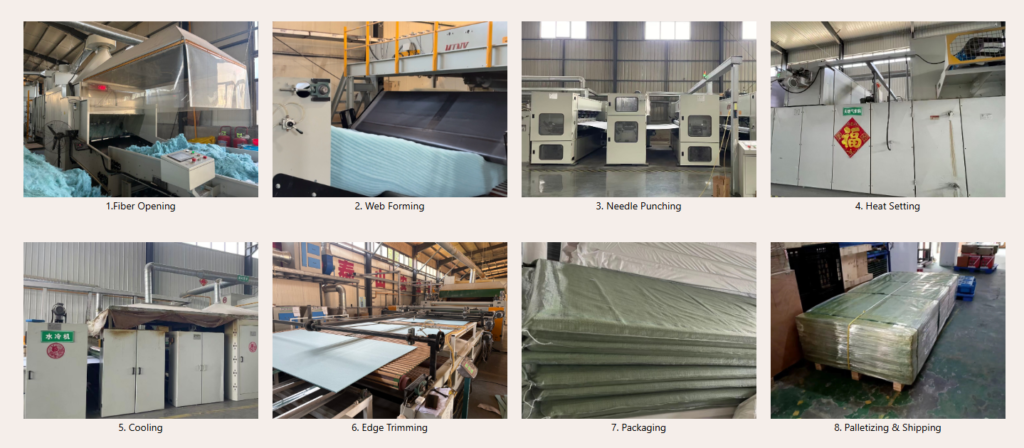
1. Fiber Opening
The process starts with polyester fiber. The compressed fibers are opened and loosened to create a more uniform and fluffy fiber structure, preparing the material for the next stage.
2. Web Forming
The opened fibers are evenly distributed to form a continuous fiber web. Uniform fiber distribution is important for achieving consistent density and thickness throughout the material.
3. Needle Punching
The fiber web then goes through needle punching. Thousands of needle movements interlock the fibers with each other, creating a stronger and more stable polyester felt structure.
4. Heat Setting
The needle-punched material is heat set to further stabilize its internal structure. This process helps control the panel’s thickness, dimensions, and flatness.
5. Cooling
After heat setting, the material is cooled to gradually stabilize its structure and prepare it for further processing.
6. Edge Trimming
The edges are trimmed to remove excess material and achieve clean, consistent dimensions. This also prepares the panels for subsequent processing and packaging.
7. Packaging
After production and quality inspection, the panels are sorted according to specifications and properly packaged. Suitable packaging helps protect the products during handling and transportation.
8. Palletizing & Shipping
The finished panels are palletized according to the order requirements and prepared for shipment. After final checking, they are ready for delivery to customers.
From Fiber to Finished Panel
The production of a polyester acoustic panel involves more than one process. Fiber opening, web forming, needle punching, heat setting, cooling, edge trimming, packaging, and shipping all work together to create a finished product with consistent quality.
For acoustic panel manufacturing, stable raw materials, well-maintained equipment, and careful process control are all important for maintaining product consistency from one batch to another.
Understanding the production process is also a simple way to understand what goes into a quality acoustic panel.